
Free K-2 Strand 1 plan

Phonological and Phonemic Awareness:
A Strand 1 Small-Group Lesson Plan

With a bit of planning (and the support of your building leader), you get 15 to 20 minutes to work your magic and improve literacy outcomes for the students in each of your small reading groups. That's it! And in the lower grades — especially with struggling readers — what you do with the first three minutes of that small-group experience could determine the flow of the next 17 minutes while also setting the stage for your students to reach new heights as readers and spellers.

This article will walk you through how phonological and phonemic awareness fit within the bigger picture of science-based reading instruction, how to structure a small-group reading lesson so that it targets the skills crucial to long-term reading success, and how the opening three minutes will help you launch a well-organized, systematic, and highly efficient plan to improve your students’ Strand 1 – Foundational Skills. At the bottom of this article, you can download the full Strand 1 Small-Group Lesson Plan for students within the Beginning Stages of Reading (typically Grades K-2) and start using it tomorrow!

Strand 1 vs. Strand 2:

Where Phonological and Phonemic Awareness Fit

Thanks to the Reading Rope schematic (2001) developed by Hollis Scarborough, as well as the Simple View of Reading promoted by Philip Gough and William Tunmer (1986), educators have come to realize that both Word Recognition and Language Comprehension play a substantial role in overall Reading Competence. However, have you ever struggled to figure out how to transform these two broad domains into an actionable lesson plan? To help, let’s start by defining and illustrating the two Strands which make up the Reading Competence Continuum.

Strand 1

Strand 1 is comprised of all the skills students need to master “to lift the print off the page.” These skills are commonly referred to as Foundational Skills. Strand 1 covers the skills that students need to perform accurately and quickly when connecting sounds to symbols to words to connected text — phonological and phonemic awareness, phonemic decoding (including word-level accuracy and automaticity) and fluency. When you’re teaching a student to recognize the sounds in spoken words, map distinct sounds onto letters, decode an unfamiliar word, or build speed, accuracy and prosody with connected text, you’re working within Strand 1.
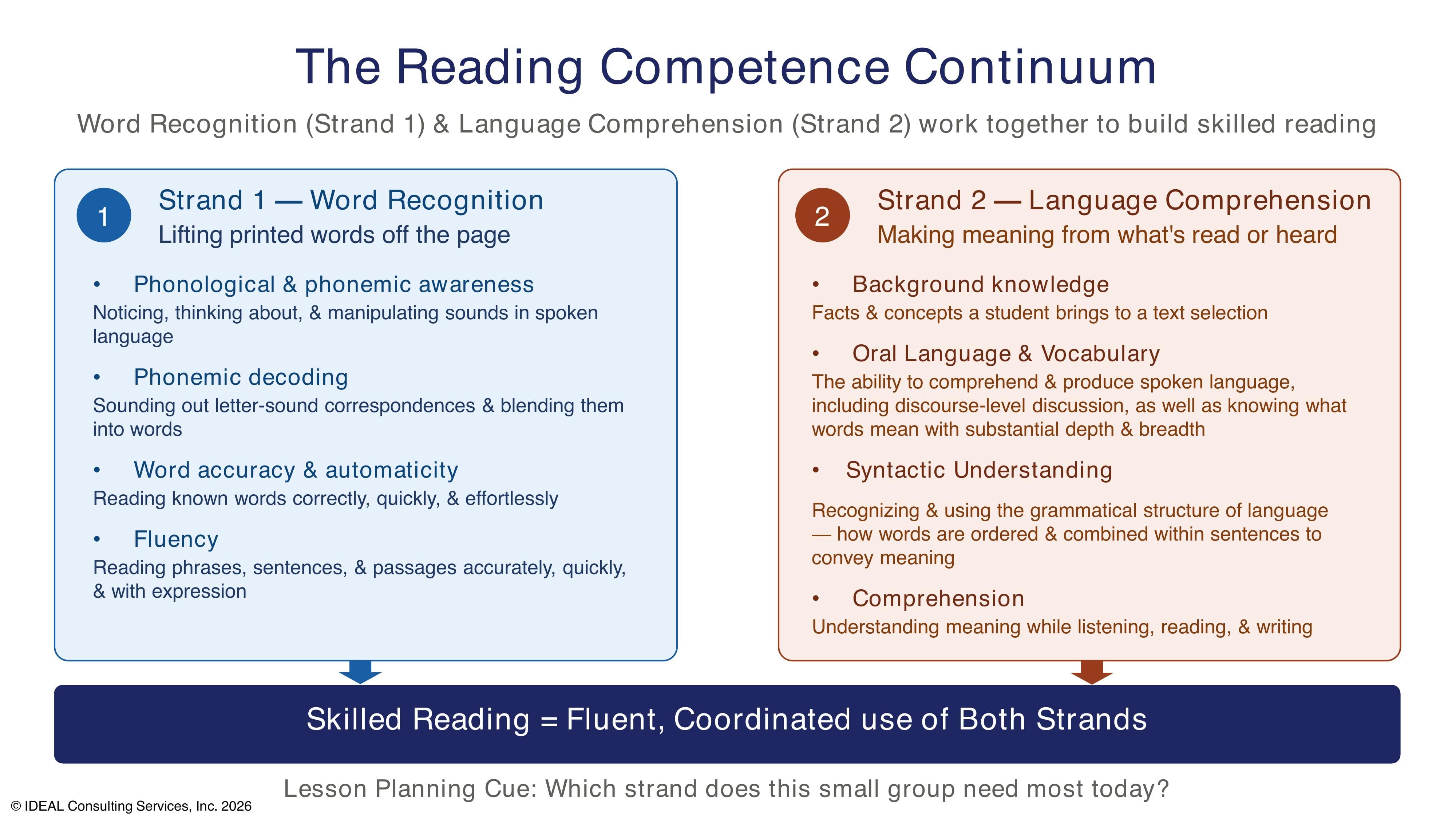
Strand 2

Strand 2 encompasses all the skills students need to master to unlock the “making meaning” side of reading. It covers everything a student draws upon to understand and reason about what’s being read or heard — oral language and vocabulary, background knowledge, syntactic understanding, and listening/reading/writing comprehension. When you’re building vocabulary, activating prior knowledge, discussing sentence structure, or asking students to interpret or evaluate a text selection, you’re working within Strand 2.

Strand 1 vs Strand 2

By conceptualizing the domains of Word Recognition and Language Comprehension into specific, research-based literacy skills, bundling them within two highly distinctive strands, and then prioritizing which strand to focus on when teaching each of your small reading groups across your literacy block, the lesson planning process will become much easier for you. This will also result in lessons that are better organized, streamlined, and increasingly effective.

Decide Beforehand:

Is It a Strand 1 Day or a Strand 2 Day?

As outlined earlier, the Reading Competence Continuum is best conceptualized as two broad strands: Strand 1 and Strand 2. Both strands are essential. However, teaching all the skills within each strand is very hard to do during a single 20-minute lesson. In fact, it is my experience that when teachers try to do so, the result is almost always a highly disjointed, ineffective lesson — too much content in too little time, covered too thinly to foster meaningful student gains.

The fix is a planning decision, made ahead of time, thus avoiding a “fly-by-night” approach to teaching the most important learning skills that your students will ever be taught. Quite simply, prior to kicking off your small reading groups for the week, decide which days you want to focus on Strand 1 versus Strand 2. Please note that the “balance” of your instructional approach between the two strands does not necessarily mean spending the same amount of time on each. The balance is contingent upon the grade you teach, the time of the year, and the performance levels of the students within each of your small groups. For your lowest performing reading groups in Grades K-2, Strand 1 days will dominate — and that's appropriate. A student who can't yet decode gains very little from a comprehension conversation about a text selection he or she can't read — unless the lesson is framed as a listening comprehension/critical thinking/language development exercise. Commit each lesson to one strand and devote every minute within the lesson towards teaching the skills considered to be the building blocks of long-term reading success.

Select a strand to focus on while teaching

  • Avoid trying to teach all literacy skills in one 20-minute small-group lesson. When Strand 1 and Strand 2 skills are blended without a clear purpose, the lesson can become disjointed and too thin to move students forward.
  • Commit each lesson to one strand. Decide before small groups begin whether the day is focused on foundational word-recognition skills or meaning-making skills.
  • Allow students' needs to help you set the balance. Consider the students' grade, their performance levels, and the time of the school year when determining how often you should teach each strand for your small groups across a given week.

Decision Rules regarding a Strand 1 vs. Strand 2 Focus

Strand 1Use for phonological and phonemic awareness, phonemic decoding, word accuracy, automaticity, and connected text fluency.
Strand 2Use for oral language, vocabulary, background knowledge, language structures, comprehension, and meaning making.
K-2 groupsFor the lowest performing beginning readers, Strand 1 days will often dominate, because students need decoding access before text-based comprehension work can land.
The CaveatListening comprehension isn't gated by decoding skill — so even when students can't yet read the text themselves, a Strand 2 lesson remains essential when it's intentionally framed as listening comprehension, critical thinking, or language development.

Strand 1 at a glance

The Focus of a Strand 1 Lesson Plan

Here's my take, based on 27 years of doing this work in over 800 classrooms across 275 school districts — a well delivered Strand 1 lesson plan will help your students learn how to effortlessly perform the key subskills within the following literacy domains:

Phonological and phonemic awareness

Phonological and phonemic awareness — the ability to notice, think about, and manipulate the sounds in spoken language — separate from print (remember the distinction - phonological awareness covers larger sound units like syllables while phonemic awareness works at the level of individual sounds).

Phonemic decoding

Phonemic decoding — the ability to translate written letters (or letter combinations) into their corresponding sounds and blend those sounds together to read words. This is where sound meets print. A student applies his or her knowledge of phoneme-grapheme relationships (the alphabetic principle) to sound out, blend, and read unfamiliar words.

Fluency

Fluency — the ability to read connected text (across numerous levels - phrase, sentence, paragraph, and passage) accurately, quickly, and with expression.

Preview the Strand 1 Routine

How to Structure a 15–20 Minute Strand 1 Small-Group Routine

Remember that when teaching the key skills within a Strand 1 lesson plan, you are devoting your time, energy, and select resources towards helping your students learn how to effortlessly crack the rather complex code that is part and parcel of an alphabetic writing system. To do this efficiently and effectively, you will want to have a set number of minutes allocated to the teaching of discrete skills. More specifically, here’s a suggested breakdown of how many minutes you should devote to teaching each skill across a 15-20 minute small-group reading lesson. This is the structure captured in the downloadable Strand 1 plan:

  1. 1–3 minutes

    Phonological/Phonemic Awareness

    Although you may have already exposed your students to a smattering of phonological and phonemic awareness skills while using a whole-group program like Heggerty, within any given lesson there is typically not enough practice items associated with each subskill to assure students’ full mastery. As such, use the opening few minutes of your small-group time to emphasize the key subskills of syllable segmenting, phoneme blending, and phoneme segmenting. Remember the following when getting ready to start your phonological/phonemic awareness “warm-up”: Oral only - No print. Think - Listening game. No downtime – 5 practice items per subskill. When appropriate, use multi-sensory scaffolds like Elkonin Boxes.

  2. 2–3 minutes

    Phonics: Sound/Symbol Correspondences

    Rapid review of taught letters for BOTH accuracy and automaticity, using alphabet arcs, letter tiles, sound spelling cards, and/or phonics grids. Students see the letter, produce the sound, and eventually learn how to do so accurately and quickly!

  3. 2–3 minutes

    Phonics: Decodable Word Blending

    Students apply their understanding of sound/symbol correspondences while using a blending strategy to decode whole words — again for accuracy and automaticity, with the use of white boards, letter boards, blending boards, and phonics grids. The goal is to help students read words containing highly regular spelling patters “the FAST way.”

  4. 2–3 minutes

    Phonics: Sight/Trick/Heart/Red Words

    Words with irregular phonetic elements get their own time for direct instruction and frequent practice to further facilitate the connected text reading process. Remember to once again use phonics grids to establish word-level accuracy and automaticity — this is important because your students will most likely view these words as “rule breakers.”

  5. 5–8 minutes

    Connected Text Fluency with Decodables

    Quite intentionally, the longest block of time is devoted to connected text reading. It is critical, though, that your students read decodable text which features the words (or words with similar spelling patterns) taught earlier in the lesson. This is when the real magic happens — isolated skills come together to become connected text READING.

  6. 1 minute

    Phonics: Dictation

    Sound-, word-, and/or sentence-level dictation to close. Encoding is decoding in reverse, and one minute devoted to it could solidify your day's work.

  7. The Takeaway

    Routine Benefits

    Consider what this structure will do for you as you try to expertly manage the challenge of meeting the unique literacy needs of each student across all your small reading groups: it front-loads the sound work, moves systematically from sounds to letters to words to connected text, and dedicates the largest amount of time to actual reading. No transitions to navigate, no decisions to make mid-lesson, and the elimination of all wonderings about where to go next. You will be able to approach the development and delivery of each lesson with stellar clarity and precision!

The 3 Most Important Minutes of a Strand 1 Lesson Plan

Phonological Awareness vs. Phonemic Awareness: What's the Difference?

Phonological awareness is an umbrella term which includes the ability to hear and work with the sound structures of spoken language — words, syllables, and onsets/rimes. Phonemic awareness is a subskill within the phonological awareness domain which is centered on the most fine-grained level of sound work — hearing, blending, segmenting, and manipulating the individual speech sounds, or phonemes, within words. Neither phonological awareness nor phonemic awareness involves print. As such, you can perform these skills with your eyes closed. Phonics is what happens when these sounds get attached to letters or letter combinations (digraphs and vowel teams). As soon as you help your students make the connection between sounds and printed letters, you have helped them cross the bridge into the land of phonics.

The ordering of these crucial skills matters. A student who can't orally blend /s/ /a/ /t/ into “sat” will most likely struggle to map these sounds onto printed letters during the beginning decoding stage of reading. Phonemic awareness is the foundation phonics is built on — which is why it opens the lesson. Yet, the question remains — how much time should be devoted to the teaching of phonological and phonemic awareness?

The Challenge — You Only Have 15–20 Minutes a Day to Drive Home Mastery

Small-group reading time is the highest-leverage, instructional opportunity most struggling readers will get all day. It's also the easiest to squander — not through lack of effort, but through lack of structure.

Here's the instructional routine I see constantly when visiting classrooms: a teacher sits down with a group and either tries to teach every skill (typically the Fab Five of phonological/phonemic awareness, phonics, fluency, oral language/vocabulary, and reading comprehension) identified as important within literacy approaches aligned with the science of reading; or, the teacher covers specific skills hastily to make extra time for book reading. There are components within each approach which are defensible. However, the former approach typically plays out as a rushed, disjointed, surface-level lesson with not enough practice opportunities for the students to fully master any of the taught skills. The latter approach forces teachers to continuously rely on the incidental teaching of critical skills while helping his or her students navigate connected text. In short, without a cohesive lesson plan, none of the skills gets enough repetition to stick, transitions continuously eat the clock, and the lesson ends with students having been exposed to numerous skills without gaining mastery of any of them!

The problem isn't the teacher. The problem is cramming too much content into a 20-minute lesson whereas your students would be better served by formulating and delivering the content across two 20-minute lessons distinguished by Strand 1 and Strand 2.

The Three Minutes That Move the Needle

So, why call the opening 2–3 minutes of a Strand 1 Lesson Plan the most important?

Because syllable segmenting, phoneme blending, and phoneme segmenting are the skills which are most predictive of long-term reading and spelling success — and they're the ones most often skipped or taught superficially.

Syllable Segmenting

The ability to break a spoken word apart into its individual syllables — each syllable being one "beat" or vowel sound in the word. For example, a student segmenting “napkin” would break it into two syllables, “nap” and “kin,” often clapping, tapping, or chopping out each beat as they say it. Performing this skill strengthens students' ear-brain connection, building the understanding that words break apart into chunks — this will eventually be the on-ramp to helping them successfully perform more granular phonemic awareness skills like phoneme blending and phoneme segmenting. Syllable segmenting will also eventually serve as an important launching pad for structural analysis, the strategy students use to read multisyllabic words. More specifically, when a student encounters an unfamiliar multisyllabic word in print — say, “disagreement” — structural analysis will equip them to do visually what they already learned to do orally: break the word into manageable chunks (dis-a-gree-ment), decode each chunk, and blend the chunks back together to read the whole word.

Example: napkin becomes nap / kin.

Phoneme Blending

This is the ability to take individual sounds spoken separately and combine them together to form a whole word. For example, if a student hears the sounds /f/ /a/ /t/ spoken one at a time, phoneme blending is the skill of merging them into the single word “fat.” Phoneme blending is a finer-grained skill than syllable segmenting: instead of working with syllable-sized chunks, students are working with individual phonemes, the smallest units of sound in language. Although phoneme blending is a phonemic awareness skill and thus, does not involve print, it's a critical bridge skill to phonics — the same blending ability students practice orally is exactly what they'll later apply to phonemic decoding, where they'll sound out letters and blend those letter-sound correspondences together to read printed words.

Example: /f/ /a/ /t/ becomes fat.

Phoneme Segmenting

This is the ability to take a spoken word and break it apart into its individual sounds, often by rolling out a finger for each phoneme. For example, if a student hears the word “map,” phoneme segmenting is the skill of pulling it apart into its individual sounds: /m/ /a/ /p/. Phoneme segmenting is the reverse of phoneme blending — instead of merging or “mushing” separate sounds into a word, students are breaking a whole word apart into its component sounds. Although phoneme segmenting is a phonemic awareness skill and thus does not involve print, it's yet another launch skill for phonics — specifically encoding or spelling. The same segmenting ability students practice orally is exactly what they'll later apply when spelling a word, translating each sound they hear into its corresponding letter or letter combination (digraphs or vowel teams).

Example: map becomes /m/ /a/ /p/.

Get the Strand 1 Plan

The full sample Strand 1 Small-Group Lesson Plan — the same structure outlined above, formatted for planning and daily use — is ready to download. Print it, use it to plan your small-group lessons, initially keep it by your side as you expertly transition from one step to the next, and allow this research-informed structure to dramatically improve reading outcomes for all your students!

Download the Strand 1 Plan

About the author

Christopher Parker, Ph.D.

President & Lead Consultant | IDEAL Consulting Services, Inc.

Dr. Chris Parker is the president and lead consultant of IDEAL Consulting Services, a company which has spent the past 27 years working with over 800 schools — making IDEAL the Northeast’s most trusted choice for all things regarding the effective implementation of Response to Intervention (RtI).

36 Years of Experience
in Education
800+ Schools Served
across 275 Districts
The Northeast's Premier Expert on RtI & MTSS

Dr. Parker and the IDEAL team help building leaders design schedules that balance adult-led whole-group instruction, adult-led small-group instruction, and student-led small-group workstations, and coach teachers and support staff to explicitly, directly, and systematically teach the core skills across the Five Components of Reading using strategies drawn from 30+ years of reading research — all as part of developing and sustaining a Multi-Tiered System of Supports (MTSS) built on a Three-Tier Intervention Model. They also help schools develop and utilize a research-based assessment system: administering, scoring, and interpreting data from universal screening, progress monitoring, and diagnostic measures – while expertly guiding school personnel during Grade-Level Data Meetings, Progress Monitoring Meetings, and Instructional Planning Meetings — all tracked through IDEAL’s own Student Performance System (SPS) database.